Role
Design Research Lead &
CMF Strategist
Timeline
2024-2025
Collaboration
Partnered with an Industrial Designer
Core Focus
Strategic CMF,
Quantifiable UX Impact, and Manufacturing Feasibility

Fuse
Strategic CMF & Data-Driven UX Design
Project Overview
The Challenge
Traditional blenders face a user adoption gap, being perceived as bulky, error-prone (62% baseline assembly error), and difficult to clean. These pain points lead to low long-term use and poor emotional engagement in the premium appliance segment.
The strategic solution
I positioned early-stage, research-driven CMF (Color, Material, Finish) as a primary strategic UX driver. The goal was to transform the product from a frustrating appliance into a prized, self-evident object, aligning it with a daily wellness ritual.
Key quantifiable results
This strategy delivered immediate, measurable gains, validating the approach:
01
Assembly error rate
75% Reduction (from 62% baseline to 12.5%) achieved by using CMF to solve assembly friction.
02
Average learning time
81% Reduction(from 4.2 minutes to 0.8 minutes), validating the Self-Evident Design principle.
03
First-time success
Achieved a 95% success rate for uninstructed first-time users, a new metric for intuitive usability.
04
Business impact
The CMF solution became a proprietary visual element that eliminated secondary processing (e.g., silk-screening), directly reducing BOM cost and manufacturing complexity.
01. Discovery & Strategic Framing
Our research identified that the challenge was not technical, but one of user adoption and emotional resonance—critical factors for premium hardware.
The core strategic question:
How can we leverage physical form and CMF to transform a cumbersome appliance into a prized, self-evident object?

Based on 32 user interviews and behavioral testing with 20 participants, I led the translation of user insights into three non-negotiable principles that served as the project's strategic compass and decision-making constitution:
Design Principle
Human Need
Design Filter (Test)
Self-Evident Design
Reduce cognitive load and assembly anxiety.
"Can a user intuitively operate this product in under 10 seconds without reading a single word?"
Ritual Experience
Elevate daily use from a task to a moment of pleasure.
"Does the core interaction elevate the task from 'functional' to 'satisfying'?"
Maintenance Minimization
Eliminate the primary barrier to long-term adoption.
"Have we aggressively minimized surfaces and complexity to ensure 5-second rinse-ability?"
02. Design & Testing: CMF as a Functional UX Tool
Our most contribution was the development and execution of a methodology that positioned CMF as a primary strategic tool to solve core UX problems, moving it from a late-stage aesthetic choice to an early-stage functional driver.
1. CMF Research: Implicit Guidance via Surface Texture
Research Hypothesis:
Surface texture can act as an "implicit guidance system," enabling correct assembly without instructions while simultaneously creating brand identity and tactile pleasure.
Methodology:
Comparative blind testing of 4 texture prototypes (controlling material and color) to measure assembly accuracy, grip comfort, and perceived quality.

Linear Circular: Clean vertical rhythm across the full container but rigid in character.

Diagonal Rhythmic: Dynamic upward flow that concealed the blade and aligned seamlessly with the lid and base.

Arc Transition: Soft arc pattern at the blade cover that emphasized transition but lacked alignment clarity.

Soft Linear: Subtle tactility and visual softness but limited functional cues.
Tested Pattern
Assembly Accuracy (Uninstructed)
Strategic Outcome
Linear, Arc, Soft
Low Accuracy (50%+ error)
Rejected for failing the "Self-Evident Design" filter.
Diagonal Rhythm
87.5% Success
UX Impact: Reduced assembly errors by 75%.
Business Impact: Proprietary visual element that eliminated secondary processing (e.g., silk-screening or labeling), directly reducing BOM cost and manufacturing complexity.

Hardware Relevance:
The diagonal pattern conceals the blade while maintaining transparency and creates an intuitive alignment system. The rhythm guides assembly without conscious thought—users report it "just feels right" when correctly positioned.
2. Interaction Research: Magnetic System for Reliability and Modularity
We structured research to validate solutions that enhance both user experience and hardware reliability:
Magnetic Assembly System
Result:
100% first-time success rate and a shift in emotional response from "clunky" to "premium, like using an Apple product."
Hardware Impact:
The magnetic connection enhances long-term reliability by reducing mechanical wear and provides a modular platform for future accessories (e.g., different capacity containers).
We also optimized the tactile and auditory feedback of the "click" to ensure a satisfying, ritualistic moment.

Hybrid Interface (Button + Gesture)
Result:
Final solution achieved a 95% first-time success rate, balancing certainty and fluidity.
Hardware Impact:
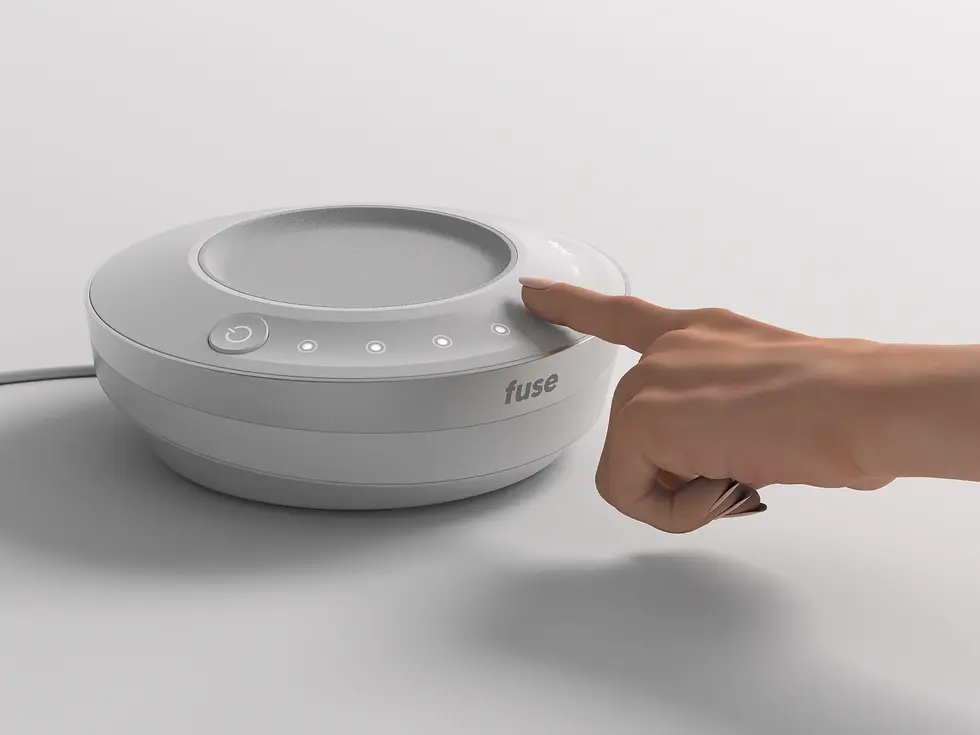
This hybrid approach was chosen to balance cost, reliability (water resistance), and UX. The physical button provides certainty for critical operations, while the gesture offers elegant secondary control, avoiding the high cost and fragility of a full touchscreen.
03. Process Integration & Transferable Frameworks
My role was to be the strategic bridge, ensuring that every design decision was an evidence-based response to user needs and manufacturable requirements.
Engineering & Manufacturing Focus:
Process Integration:
I ensured the Discover → Hypothesize → Prototype → Test → Refine research cycle was tightly integrated with the engineering and manufacturing timeline, providing actionable data within the design freeze window.
Translating Abstract Insights to Engineering Specs
I successfully translated abstract insights (e.g., "Ritual Experience") into concrete engineering specifications, such as defining the required magnetic connection force (in Newtons) to ensure both reliable connection and easy separation.
Transferable Frameworks:
CMF Strategic Framework:
A proven methodology for isolating CMF variables to solve functional UX problems at the beginning of the design process.
Insight → Principle → Filter Question:
A reusable framework for translating abstract user insights into actionable, non-negotiable design criteria for the entire product team.
04. Final Reflection
This conceptual project challenged me to think beyond traditional research boundaries. The breakthrough wasn't the 87.5% accuracy metric—it was discovering that texture could serve as an unconscious guidance system, potentially eliminating instruction manuals entirely.
The diagonal pattern solution exemplifies how constraint-driven research (cost, manufacturing, user needs) can produce unexpectedly elegant solutions.
Most importantly: CMF isn't cosmetic. It's functional UX.
